(This LAB uses version r25.12.1 of MESA)
3. Evolving to Core-collapse (BONUS)
This lab will continue using the downloaded changing_rates directory from the previous lab, where we evolved our stellar model until the end of core-Helium burning. Let’s copy over the directory with a new name or redownload it from here: Changing_rates.
cp -r changing_rates evolving_to_cc
Science goal
The goal of this lab is to evolve our stellar model from Helium depletion to core-collapse, and then to anylize the differences in stellar model behavior across varying phases of evolution with respect to the chosen $^{12}$C$(\alpha,\gamma)^{16}$O rate adopted.
Again, we highlight emphasize that the actual final value of $M_{CO}$ at core-collapse can be influenced heavily by the occurence of shell mergers during Carbon or Oxygen burning. See Laplace et al. 2025 $M_{CO}$ is not a self consistent proxy for the Chandrasekar mass of the collapsing core. Instead one must actually look at the structure, and specifically the electron fraction $Y_{e}$ of the collapsing core Boccioli et al. 2024. The actual relation between $M_{CO}$ and $M_{ch}$ and the final remenant mass $M_{rem}$ is more complicated than the simplified picture presented in this lab (and often assumed in population synthesis codes). Even then, accurately capturing the mapping between $M_{CO}$, $M_{ch}$, and $M_{rem}$ remains an active area of research. Another notable work which studies this mapping in the context of binary population synthesis models is Patton et al. 2020
Evolving to Carbon depletion
 TASK TASK |
|---|
change the stopping condition in the &controls such that the stellar model evolves until the core-Carbon depletion when the central mass fraction of Carbon drops below $10^{-3}$. See MESA &controls documentation: When to stop. |
| Run the model and look to see if Carbon ignited radiatively or convectively. |
Evolving to Oxygen depletion
|
TASK |
|---|
change the stopping condition in the &controls such that the stellar model evolves until the core-Oxygen depletion when the central mass fraction of Oxygen drops below $10^{-3}$. See MESA &controls documentation: When to stop. |
| Run the model, consider restarting from your last saved photo! |
Answers: Evolving through CO burning
Below is a pgstar ilustrating the evolution through Carbon and Oxygen burning (and Neon melting), for $\sigma\_{C12} = 0$Evolving to core-collapse
|
TASK |
|---|
change the stopping condition in the &controls such that the stellar model evolves until the Fe core is infalling at 100 km/s. See MESA &controls documentation: When to stop. |
| Run the model |
 HINT HINT |
|---|
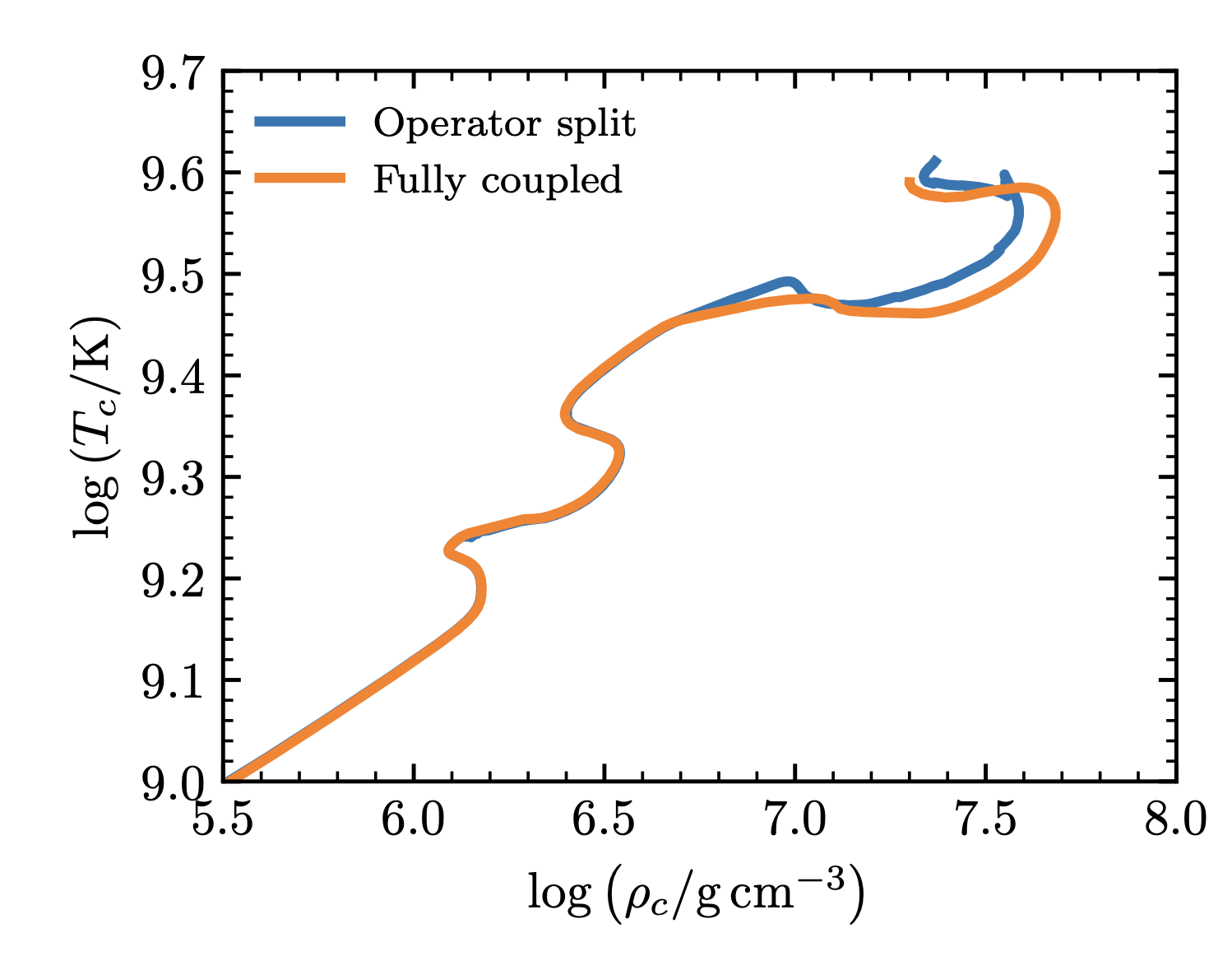
If the stellar model struggles during late burning and stalls, consider operator splitting the nuclear reaction network to improve the numerical stability of the stellar model op_split_burn = .true.
|
| Keep in mind, this will change the results! |
Figure from MESA VI